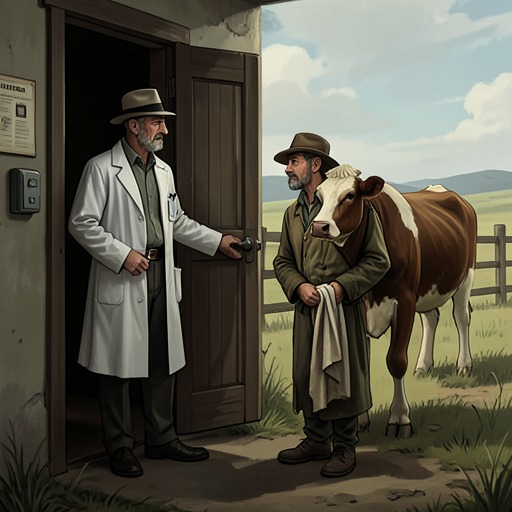
Cranford’s ointment and manure samples are sent in the wrong parcels
All Creatures Great and SmallThe misdelivery of Isaac Cranford’s boar ointment and a manure sample turns an ordinary piece of veterinary-office work into a comic escape from a chronically difficult client. Tristan Farnon confuses two parcels at Skeldale House: Isaac Cranford receives a tin of cow dung with instructions to rub its contents on a prize boar, while a laboratory in Leeds is sent ointment instead of the sample required for a test for Johne’s disease. The error seems at first to risk both the boar’s health and legal action against the practice. Instead, the indignity of explaining the incident proves more powerful than Isaac Cranford’s anger.
A Client Already at Odds with the Practice
The mix-up occurs against a history of mistrust. Isaac Cranford has blamed the practice over an earlier lightning-related case and will not allow James Herriot near his farm. He also complains that the veterinarians do his animals no good and objects to his bills. Yet he remains a client: Herriot observes that Isaac Cranford receives first-rate service and that his complaints may be part of a way of keeping the charges down. Siegfried Farnon, who would gladly lose him, finds the persistence both exasperating and unsettling. This uneasy arrangement gives the parcel episode its particular stakes: the mistake lands not with a forgiving regular, but with a farmer who already believes the practice has failed him.
The immediate task is straightforward. Siegfried Farnon carefully mixes ointment for Isaac Cranford’s prize boar, which has a sore across its back. A blemish could damage the boar’s success at shows and cost its owner money. At the same time, Siegfried Farnon prepares a faeces sample for laboratory testing for Johne’s disease. The sample arrives in a treacle tin because the practice has run out of small glass jars. The improvised container is not unusual in itself: farmers commonly send far more dung than a test requires, using whatever large container is at hand. Here, however, the tin’s size and contents will make the mistake impossible to mistake for anything else.
Two Parcels and One Wrong Pair of Labels
Siegfried Farnon hands the posting jobs to Tristan Farnon. He has him put the ointment in its box, attach instructions for applying it to the boar’s back, and send it to Isaac Cranford. The treacle tin, tightly lidded and wrapped in brown paper, is to go to the laboratory in Leeds. Tristan looks along the shelves for sample jars, learns they are out, and proceeds with the tin. The two packages leave the practice; the error is in their labels, not in the intended treatments.
Three days later, Isaac Cranford’s name reappears in the morning mail. Siegfried Farnon reads a letter on blue notepaper and tells Herriot that its language is vitriolic. Isaac Cranford says the practice has grossly insulted him and endangered his boar’s health: he has received a tin full of cow dung with instructions to work it into the animal’s back. The wrongly addressed manure sample has transformed a routine mailing error into something that, from the recipient’s point of view, looks like a deliberate obscenity. He says he is finished with the practice and is considering legal action.
Tristan Farnon recognizes the danger and tries to leave the room. Siegfried Farnon calls him back and, rather than immediately erupting, calmly identifies what has happened: Tristan has put the wrong labels on the two parcels. Tristan cannot explain how he made the mistake. The labels and their contents have crossed, sending the cow dung to Isaac Cranford and the ointment to the laboratory.
Dignity Over a Courtroom Complaint
Siegfried Farnon’s response shifts the episode from threatened disaster to dark comedy. He concludes that Tristan Farnon’s habitual bad luck has, in this instance, helped the practice. Isaac Cranford opened the package at the breakfast table; the ointment’s directions would have told him to work the substance into the boar’s back with his fingers. Taking the complaint to court would require Isaac Cranford to explain the contents and instructions in public. Siegfried Farnon believes that his client’s strong sense of dignity will prevent him from doing so.
The letter is crumpled and dropped into the waste-paper basket. Nothing in the episode establishes that Isaac Cranford withdraws his complaint in a formal exchange; the immediate consequence is that Siegfried Farnon treats the legal threat as neutralized and turns back to work. The reversal is comic because it depends not on a correction or apology, but on the complainant’s reluctance to make his own humiliation public. The practice’s survival rests, for the moment, on the very embarrassment that the mistake has caused.
The Last Turn of the Joke
The incident’s final joke comes after Siegfried Farnon has led the others into the passage. He stops and raises another consequence of the crossed parcels: the laboratory, he wonders, may now be testing the ointment for Johne’s disease. The question extends the original error beyond Isaac Cranford’s outrage. The laboratory has received a substance intended for a skin complaint on a boar, and the sample sent for diagnosis is in the hands of the client. The episode does not report a laboratory result or show what happens to either parcel afterward; its ending rests on the absurd possibility created by the mislabelling.
The scene compresses the practice’s everyday risks into a chain of physical objects: a carefully mixed ointment, a treacle tin, two labels, and a crumpled letter. Each object changes meaning as it travels. The tin is a practical substitute for a missing sample jar, then the apparent evidence of an insult; the ointment is a treatment for a valuable show boar, then the unlikely material that may be undergoing a laboratory test. Against Isaac Cranford’s standing grievances and Siegfried Farnon’s wish to be rid of him, Tristan Farnon’s simple posting mistake briefly makes the relationship look irreparable. Its accidental resolution, achieved through the client’s silence rather than reconciliation, makes the episode a sharp instance of the precarious, improvisational comedy of veterinary practice.